|
The sacrament of baptism ushers us into the divine life, cleanses us from sin, and initiates us as members of the Christian community. It is the foundation for the sacramental life.
At baptism, the presider prays over the water:
Father, look now with love upon your Church, and unseal for her the fountain of baptism. By the power of the Holy Spirit give to this water the grace of your Son, so that in the sacrament of baptism all those whom you have created in your likeness may be cleansed from sin and rise to a new birth of innocence by water and the Holy Spirit. (Christian Initiation of Adults, #222A)
Freed from Sin:
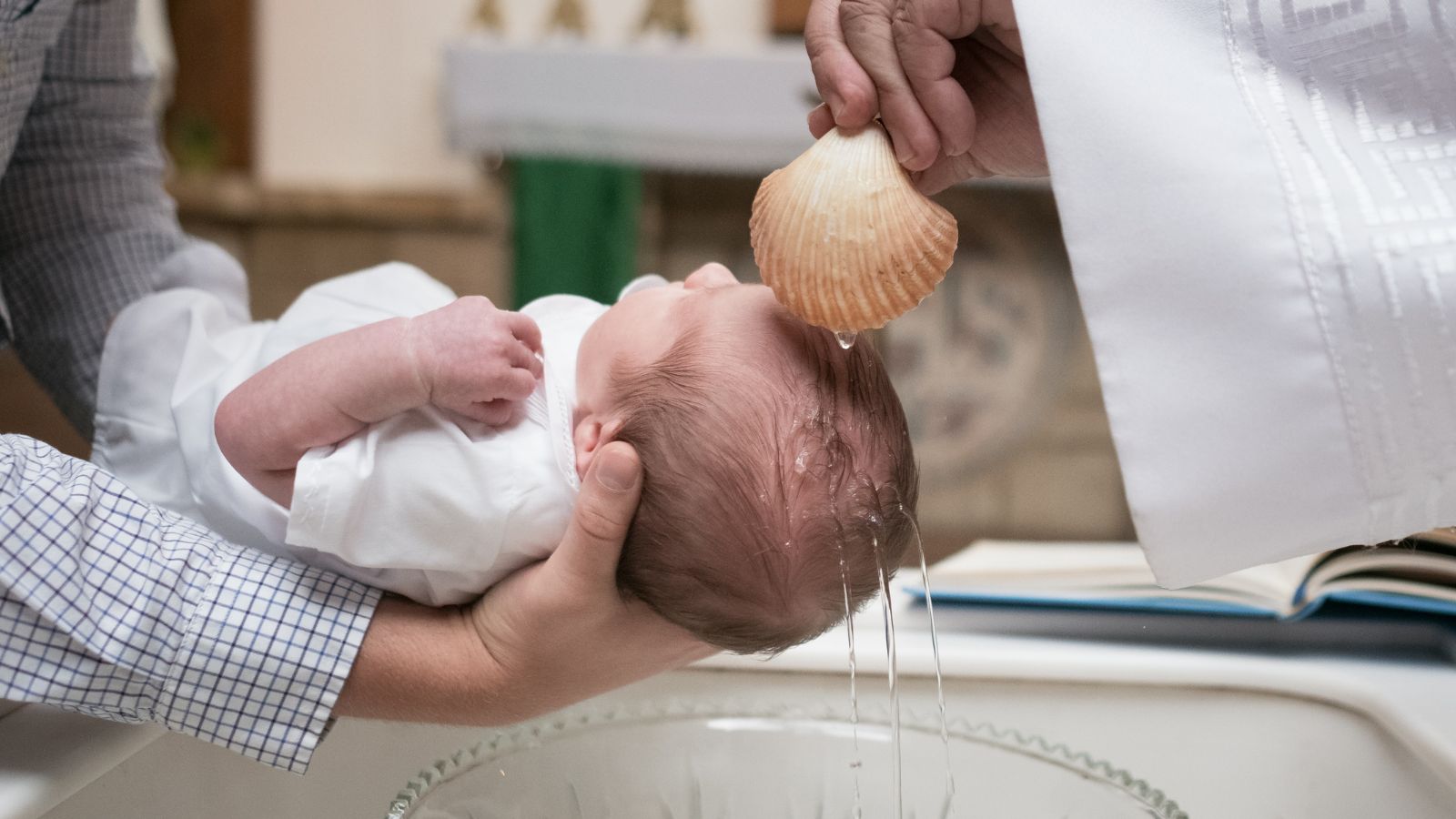
Baptism frees us from the bondage of original and actual sin. Water is poured in the name of the Father, the Son and the Holy Spirit. Today, the sacrament of baptism is often performed on infants, shortly after birth. Adult baptisms take place at the Easter Vigil through the restored Rite of Christian Initiation for Adults. Adults or children who have been baptized in a valid Christian church are not baptized again in the Catholic church. As we say in the Nicene Creed, “I confess one Baptism for the forgiveness of sins…”
The Catechism teaches:
"The fruit of Baptism, or baptismal grace, is a rich reality that includes forgiveness of original sin and all personal sins, birth into the new life by which man becomes an adoptive son of the Father, a member of Christ and a temple of the Holy Spirit. By this very fact the person baptized is incorporated into the Church, the Body of Christ, and made a sharer in the priesthood of Christ" (CCC 1279).
Baptismal Symbols:
- Water – The waters of baptism recall Jesus’ own baptism by John the Baptist in the river Jordan. Water is a symbol of cleansing and renewal as we begin a new life in Christ. We are washed clean of sin.
- Oil – At baptism we are anointed into the life of Christ as “priest, prophet and king.” A cross is traced on the candidate’s forehead as a reminder that we are inheritors of the Kingdom of God.
- Light – The baptismal candle is lit from the Paschal or Easter candle that stands in the church as a sign of Christ’s light in the world. At baptism, we receive the light of Christ and are called forth to share this light with the world.
- White garment – The white garment that is placed upon us at baptism is a symbol of Christ’s victory over death and his glorious resurrection. Likewise, the white garment or pall that is placed over the coffin at the time of death recalls our baptismal promises and reminds us that we are destined for eternal life.
While in ordinary circumstances, sacraments in the Catholic Church are administered validly by a member of the ordained clergy, in an emergency situation, the sacrament of baptism can be administered by anyone. In case of necessity, any person can baptize provided that he have the intention of doing that which the Church does and provided that he pour water on the candidates head while saying: “I baptize you in the name of the Father, and of the Son and of the Holy Spirit" (CCC 1284).
To receive the Sacrament of Baptism at Sacred Heart Parish, Miami, Oklahoma complete the Baptism Request form, supply a copy of the Certificate of Birth and contact the pastor for preparation for parents and godparent(s). Canon Law encourages infant baptism with parents and the faith community providing Christian formation as the infant matures. If the recipient of the Sacrament is already seven years of age [the age of reason] or older, pre-baptismal formation is called for.
The process for adult formation for baptism is called the Rite of Christian Initiation of Adults (R.C.I.A.).
|
El sacramento del bautismo nos introduce en la vida divina, nos limpia del pecado y nos inicia como miembros de la comunidad cristiana. Es el fundamento de la vida sacramental.
En el bautismo, el que preside reza sobre el agua:
Padre, mira ahora con amor a tu Iglesia, y abre para ella la fuente del bautismo. Por el poder del Espíritu Santo da a esta agua la gracia de tu Hijo, para que en el sacramento del bautismo todos los que has creado a tu semejanza sean limpiados del pecado y resuciten a un nuevo nacimiento de inocencia por el agua y la Espíritu Santo. (Iniciación Cristiana de Adultos, #222A)
Liberado del pecado:
El bautismo nos libera de la esclavitud del pecado original y actual. Se vierte agua en el nombre del Padre, del Hijo y del Espíritu Santo. Hoy en día, el sacramento del bautismo se realiza a menudo en bebés, poco después del nacimiento. Los bautismos de adultos tienen lugar en la Vigilia Pascual a través del Rito restaurado de Iniciación Cristiana para Adultos. Los adultos o niños que han sido bautizados en una iglesia cristiana válida no son bautizados nuevamente en la iglesia católica. Como decimos en el Credo de Nicea, “Confieso un Bautismo para el perdón de los pecados…”
El Catecismo enseña:
"El fruto del Bautismo, o gracia bautismal, es una rica realidad que incluye el perdón del pecado original y de todos los pecados personales, el nacimiento a la vida nueva por la que el hombre se convierte en hijo adoptivo del Padre, miembro de Cristo y templo del Espíritu Santo. Por este mismo hecho, el bautizado se incorpora a la Iglesia, Cuerpo de Cristo, y se hace partícipe del sacerdocio de Cristo» (CIC 1279).
Símbolos bautismales:
- Agua – Las aguas del bautismo recuerdan el propio bautismo de Jesús por Juan el Bautista en el río Jordán. El agua es un símbolo de limpieza y renovación al comenzar una nueva vida en Cristo. Somos lavados limpios de pecado.
- Aceite: en el bautismo somos ungidos en la vida de Cristo como "sacerdote, profeta y rey". Se traza una cruz en la frente del candidato como recordatorio de que somos herederos del Reino de Dios.
- Cirio pascual que se encuentra en la iglesia como signo de la luz de Cristo en el mundo. En el bautismo, recibimos la luz de Cristo y somos llamados a compartir esta luz con el mundo.
- Vestimenta blanca: la vestidura blanca que se nos coloca en el bautismo es un símbolo de la victoria de Cristo sobre la muerte y su gloriosa resurrección. Asimismo, la vestidura blanca o paño mortuorio que se coloca sobre el ataúd en el momento de la muerte recuerda nuestras promesas bautismales y nos recuerda que estamos destinados a la vida eterna.
Mientras que en circunstancias ordinarias, los sacramentos en la Iglesia Católica son administrados válidamente por un miembro del clero ordenado, en una situación de emergencia, cualquier persona puede administrar el sacramento del bautismo. En caso de necesidad, cualquier persona puede bautizar con tal de que tenga la intención de hacer lo que hace la Iglesia y con tal de que derrame agua sobre la cabeza de los candidatos diciendo: “Yo os bautizo en el nombre del Padre, y del Hijo y del Espíritu Santo" (CIC 1284).
Para recibir el Sacramento del Bautismo en la Parroquia del Sagrado Corazón, Miami, Oklahoma, complete el formulario de Solicitud de Bautismo, proporcione una copia del Certificado de Nacimiento y comuníquese con el párroco para la preparación de los padres y padrinos. El derecho canónico fomenta el bautismo infantil con los padres y la comunidad de fe proporcionando formación cristiana a medida que el niño madura. Si el receptor del Sacramento ya tiene siete años [la edad de la razón] o más, se requiere una formación prebautismal..
El proceso de formación de adultos para el bautismo se denomina Rito de Iniciación Cristiana de Adultos (R.C.I.A.). |